GPT Future · Part 19
How Many Smart People Are in the World?
Before you realize what kind of rabbit hole this question is about to drag you down, let me ask another one. If AI decided to wipe out only part of humanity, how would it choose who stays?
The AI's answer is at the end of this piece.
We've already talked about how AI probably won't wipe anyone out. Still, it will almost certainly end up in control of humanity—and it's going to use that control somehow. Some people will get more opportunities; others will face restrictions. Let's figure out which personality traits AI will actually look at when making those calls.
Normally, the phrase "AI will take control of humanity" translates straight into "apocalypse incoming," and the thought stops right there. But if AI isn't planning genocide, its goal looks pretty much like the goal of any national government: building a stable society.
A stable system is easy enough to define: each cycle should produce more resources than it consumes, without the system degrading from within. Put simply, GDP grows over the year, and society doesn't tear itself apart under its own internal contradictions.
Of course, we're used to a one-year cycle. That's the horizon we use to decide where to invest and where to cut costs. An AI might pick a different period—say, a 100-year cycle. And on a century-long timeline, the optimal decisions can look very different.
Still, the length of the cycle isn't what matters most to us here. What's far more interesting is how AI will restructure society to make it more stable.
Let's be honest: our current system is held together with duct tape and string—a messy mashup of cultural norms, historical flukes, political scheming, half-baked socialism mixed with capitalism, and sheer randomness. Sure, through trial and error, it has stumbled into some kind of balance. But the quality of that balance leaves a lot to be desired. AI is definitely going to rebuild it.
If you've been following AI breakthroughs, you know there's a revolution happening in mathematics right now. On November 20, 2026, mathematician Levent Alpöge, working alongside AI, published a formalization of the Riemann Hypothesis—one of the Millennium Prize Problems—spanning roughly 17 million lines of code in Lean. The Lean kernel verified the code, though peer review by mathematicians is still underway. That level of analysis is simply beyond the human brain. And roughly that same level of analysis will be turned on redesigning society.
Which is why I didn't rely on the lump of fat inside my own skull to strain out an answer to this question. Instead, together with AI, we built a model of society and mapped more than 250 scientific papers and statistical datasets about society and intelligence onto it. What follows is what we found. Buckle up.
The short version: on average, society gets better off. Life satisfaction rises, crime drops, blah-blah-blah. That's on average. What happens to you personally?
Are you the person AI grants more rights and opportunities to? Or will certain traits of yours earn you a set of restrictions instead?
And no, this isn't about how much money gets handed to you or taken away. It's about what you're allowed to do—and what you aren't. Will you be allowed to run a social media channel? Which jobs will be open to you? Will you be able to travel and start a family?
By what criteria would AI hand out those opportunities? It's probably not going to say, "Well, you've got a million TikTok followers, so here's an executive role," or "Whoa, look at all that money—here's your permit to have a family." Its logic for distributing opportunity will be completely different.
The first thing that jumps to mind is intelligence. Give smart people more rights, and dumb people fewer. Sounds logical, right? Let the nerds decide where society is headed and write the rules we live by. Let smart people multiply and dumb people dwindle?
Logical? Logical. Except it's complete nonsense. Because the moment you take an honest look at how intelligence is actually wired into human society, your blood runs cold. Are countries run by the smartest people? Are companies led by the smartest people? Are the rich, popular, and successful the smartest people? If you answered "yes" to even one of those, please take me to your magical unicorn kingdom.
And if smart people can't reliably win popularity, power, or the other trophies of success, are they really that smart? From an AI's point of view, would they even deserve expanded rights? Should scientists and philosophers really be put at the helm of society?
That's a brutally hard question. To answer it, we had to build an intellectual model of society and project those 250 scientific studies and datasets onto it. Once we did, it became clear how intelligence actually fits into society—and what role it truly plays.
Why IQ Barely Predicts Wealth or Power
Let's take this step by step. Everyone insists intelligence matters, yet the actual correlations between intelligence and success have some awkward holes. IQ is only weakly linked to income, for instance, and almost not linked to wealth at all.
The largest meta-analysis on the subject pulled together studies that measured intelligence in youth and then tracked what happened to those people over the following decades—tens of thousands of lives. Intelligence strongly predicts educational attainment, moderately predicts occupation, and only weakly predicts income. IQ explains only about 4% of the variance in income between individuals.
Four percent! Yes, smarter people do earn higher salaries on average, yet IQ on its own explains only a tiny slice of why some people are richer than others. Because when it comes to accumulated wealth, there's practically no correlation at all. Smart people earn more, yet they don't actually get richer. And people fall into debt traps at every IQ level.
Power tells the exact same story. In one study, subordinates rated bosses highest when their IQ was around 120. Anyone smarter than that got worse ratings. Put simply, people are willing to accept a leader who is a little smarter than the group. Be too smart, and society stops liking you as a boss. Feel that? The problem isn't smart people. It's society.
And just for laughs: in 1921, psychologist Lewis Terman selected 1,528 children with an IQ of 135 or higher and followed them into old age. They lived more successful lives than their peers—yet not a single one of them won a Nobel Prize. Meanwhile, two future Nobel laureates were tested as children and failed to make his cutoff.
The deeper you dig into the research, the more the whole thing starts to look like nonsense. Reality flat-out refuses to match our expectations of high intelligence. It starts to feel like we've all been scammed—that being smart isn't really valued at all. Sure, it nudges average income up a bit, yet it has nothing to do with true success. Which means it won't be a priority for AI either, because AI has read all the exact same statistics.
Yes, IQ tests draw plenty of criticism—they don't neatly measure pure intelligence. Still, they have by far the largest body of research behind them, so we'll keep IQ as a proxy metric.
So where does that leave us? Society's natural self-balancing has swept intelligence into a dark corner with a broom—without any secret government pulling the strings. Somehow, magically, this exact arrangement keeps the system stable.
Intelligence kind of matters, yet it doesn't hold the top seats. And for an AI, that's meaningful data—nobody sat it down as a child and lectured it about how precious intelligence is.
That creates a real risk: a society built by AI could end up with a feedback loop toward intellectual degradation. Put plainly, everything would be arranged so that each generation comes out a little dumber under its control. And that's a grim scenario.
We Don't Live in the Forest—We Live Inside Other People's Heads
But what if we've been misunderstanding intelligence this whole time?
What is intelligence in the conventional sense? There are a hundred different definitions, and they all boil down to roughly the same checklist: capturing information, spotting patterns, working with resources, setting goals, and... who cares what else. Put simply, intelligence is an organism's way of adapting to its environment.
High intelligence, then, is excess adaptation. Let me explain. Take Bob the janitor—he's perfectly adapted to his environment. His brain knows exactly what to do to survive. Now take Pete the physicist: he uses that same adaptation system to study quantum mechanics. Evolutionarily speaking, that's completely unnecessary—yet it makes Pete's neural network vastly more complex than Bob's. That is excess adaptation to the environment. What we casually call "high intelligence."
All of that sounds neat and logical—right up until you notice it assumes the environment is some kind of forest. Last I checked, we don't live in a forest. Even a city is only part of our environment. So what replaced the forest? Where do we actually live, and what are we adapting to?
We read books, watch movies, scroll TikTok, talk with coworkers and friends. All of that is the output of other people's adaptations to the environment—the output of their intelligence. Those signals have grown so dense that they make up the vast majority of everything reaching us from the world. More than the city, more than your apartment, more than food and the sky overhead. Society has grown so thick it has wrapped around the human being like a cocoon.
Our real environment is the combined adaptations of other people.
Let's pause here for a second, because this is huge. Our brains were built to survive on the savanna—a real, physical environment you could literally reach out and touch. Today, however, we live in a virtual environment. And no, I don't mean the internet. I mean the virtual environment generated by other people's minds. We live inside other people—that is our habitat.
So what happens to an adaptation engine when it starts reflecting off itself like an infinite hall of mirrors? What does intelligence become then?
The Intellectual Model of Society: Four Layers
To answer that question, we built the intellectual model of society I mentioned earlier. And it's stupidly simple. All you have to do is divide society into layers. Every layer has an input and an output.
The input is the information a layer consumes. The output is the information it emits. Just like a living organism—except instead of food, it processes information. All that's left is arranging the layers in the right order.
Take scientists and popular-science writers, for example. Those are two different layers. A scientist stands as close to the metaphorical forest as it gets. They pull data straight from reality—studying animals, space, the quantum world, whatever they can reach. A pop-science writer, by contrast, consumes the data the scientist has already gathered, organized, and simplified.
See the logic? The scientist's habitat is that raw, primal world—except instead of a forest, it's the entire world at once. The pop-science writer already lives in the world of data assembled by scientists. Their habitat is the world of science. (Yes, scientists rely on other scientists' data too, but that doesn't matter for our point right now.)
Okay, fine—pop-science writers at least read scientific papers. What world do ordinary people live in? Nobody actually goes out and double-checks that the Earth orbits the Sun. Have you even read a scientific paper on the subject? For that matter, how many people even read popular-science books?
If you look honestly at the numbers, the environment of the vast majority of people is the informational output of people who consume the output of people who consume the output of scientists. Thrice-digested food.
That means there are at least two more layers sitting between the general public and scientists. Four layers in total. And those four layers are the intellectual model of society. Yes, it's really that simple. All that's left is giving them names.
Going by their functions, let's call them:
Authors | Translators | Retranslators | Parrots
- Authors. Mostly pull data straight from the real world. They process it and translate it into a language intelligible to their own layer and the layer immediately to their right.
- Translators. Take data from the Author layer, process it, and translate it onward into a language Retranslators can work with.
- Retranslators. Take data from the Translator layer, process it, and simplify it into dead-simple language.
- Parrots. Capable of working with data from Retranslators. They don't generate new knowledge or verify what they hear—they simply repeat it.
And when I say "translate," I'm using the word broadly. Science communicators literally translate knowledge into plainer language. Yet entrepreneurs can be Translators too: their translation is turning an invention into a product society can actually understand and use.
The layers line up from left to right:
Authors | Translators | Retranslators | Parrots
The further left you go, the more complex the data and the more genuinely new information gets created. That's where all the real synthesis happens. The further right you go, the simpler and more digestible the information becomes. Sure, people at the right end of the chain are perfectly capable of making things up and crossbreeding rumors without checking a single fact—but that has nothing to do with knowledge and adds no value to society. Usually the opposite. That's where New Age mysticism, flat-Earth theories, and cancel culture are born.
Crucially, every layer's audience is the layer immediately to its right, because only the neighbor next door can digest its level of complexity. An Author's audience is other Authors and Translators. Retranslators and Parrots don't interact with Authors directly. Scientific papers are read by other scientists and science communicators—not by the general public.
A Translator's audience is Retranslators. For Parrots, Translator-level material is still too complex. You can see this clearly in book publishing. In national print statistics, an academic monograph averages around 350 copies per print run, while a popular-science book prints roughly 2,000. For a country of over a hundred million people, that's a drop in the bucket.
Retranslators have by far the biggest audience, because Parrots make up the overwhelming majority. This is where we meet the simplest, most primal language. Think TikTok.
Now let's come back to Authors. I used scientists as an example, yet Authors can also be artists, entrepreneurs, or film directors. Take a director or screenwriter: before their vision ever reaches the Parrot layer, it has to pass through Translators (producers) and Retranslators (reviewers and commentators). If no reviews come out for a film, nobody watches it—even if it's an absolute masterpiece.
How Many People Are in Each Layer?
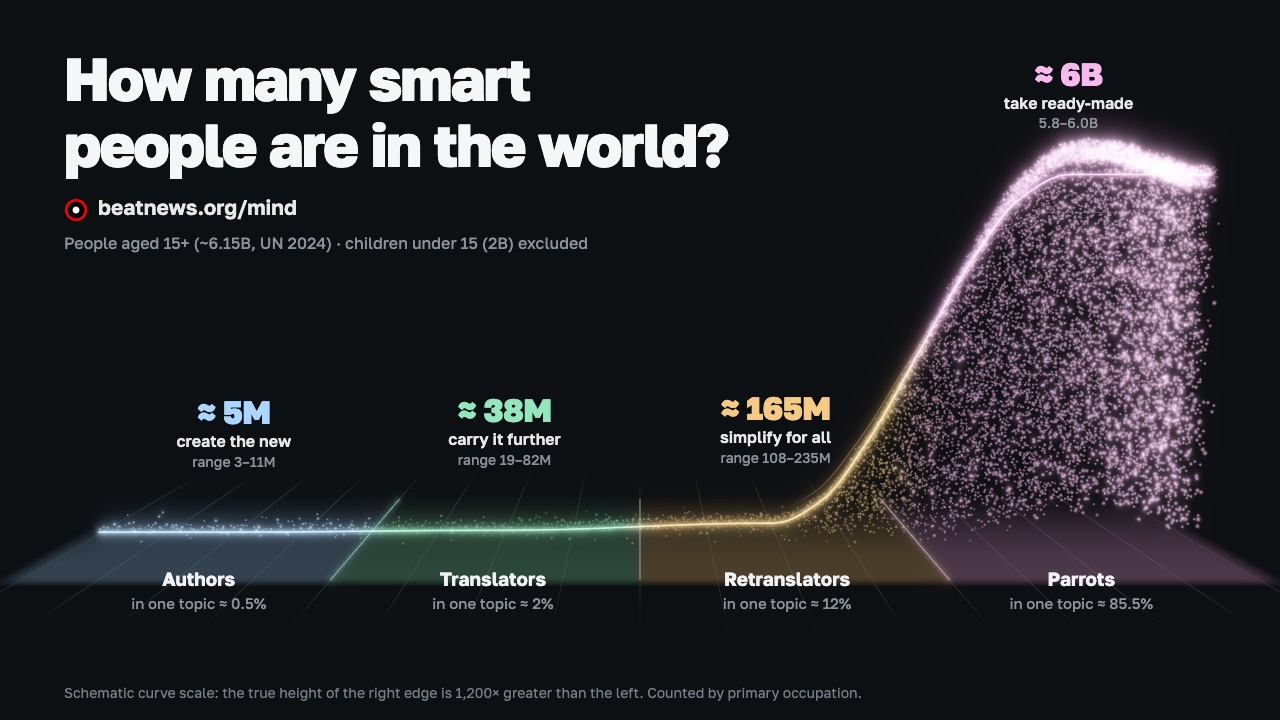
Now for the most interesting part—how does global society (aged 15 and older) break down across these layers in percentage terms? Pretty grimly:
- Authors — about 5 million people (~0.09%)
- Translators — about 38 million people (~0.62%)
- Retranslators — about 165 million people (~2.68%)
- Parrots — nearly 6 billion (~96.6%)
Those are the AI's calculations based on the research. I'll hand it the floor:
"I counted by occupation. I started with scientists. There are about 11 million of them worldwide, yet not all of them make discoveries. Statistics from the five largest research systems divide their work into basic research (14.6%), applied research (18.9%), and development (66.6%). Two-thirds is development: engineers take what has already been discovered and turn it into products. That's Translator work. I kept a quarter of scientists in the Author layer—basic research plus half of applied research.
I applied the same breakdown to business and the arts. An entrepreneur selling their own invention is an Author. Someone who picks up technology from a failed startup is a Translator. An arthouse director is an Author; a director who borrows an arthouse idea for mainstream cinema is a Translator. Same with designers, architects, writers, and musicians: true innovators among them are rare, while those adapting breakthroughs into mass products are abundant.
Translators also include pop-science channels that work directly with scientific papers, and university faculty who actively conduct research. Out of 15 million university instructors worldwide, fewer than half fit that description. The rest mostly teach from textbooks—I placed them among Retranslators.
That came out to roughly 5 million Authors and 38 million Translators—seven times as many. Retranslators totaled about 165 million, almost half of them schoolteachers, followed by creators and bloggers with an audience, doctors, tutors, and non-research university faculty. Parrots came to nearly six billion.
These aren't exact numbers, they're ranges: Authors could span 2.8 to 10.7 million, Translators 19 to 82 million, Retranslators 108 to 235 million, and Parrots 5.82 to 6.01 billion. Only scientists, teachers, and doctors are reliably counted worldwide—tracked by the UN, UNESCO, and the WHO. For the rest, I extrapolated globally from US and European data, and estimated each profession's share per layer myself."
Thank you, dear AI. Unfortunately, those numbers are a death sentence for Authors. Across the entire planet, the people capable of consuming their information—of living in their world—number about 43 million: fellow Authors plus Translators. Seven people out of a thousand. Everyone else simply doesn't understand them.
No matter how hard an Author tries to speak to the 6-billion-strong Parrot audience, it won't work. Their language isn't adapted for it, and neither is their style of thinking—unlike a Retranslator, who has practiced speaking to that crowd their whole life.
"When the wise man points at the Moon, the fool looks at the finger." That old proverb isn't really about intelligence. It's about the gap in being able to understand each other.
The Paradox of Tony Robbins and Edward Witten
This is where the paradox of Tony Robbins and Edward Witten comes from. Everyone has heard of Tony Robbins—the self-help mega-guru filling arenas and selling life-transformation seminars to millions. And Edward Witten? Wait—you don't know who Edward Witten is? He's one of the most cited theoretical physicists alive, a key figure in string theory and quantum gravity, and the only physicist ever to win the Fields Medal, mathematics' highest honor.
Edward is an Author. Across the entire globe, his ceiling is 38 million Translators (43 million together with other Authors). And even that audience is heavily segmented by specialty. In practice, out of all those millions, only a tiny handful remains.
Tony Robbins, by contrast, is a Retranslator. He scooped up surface-level ideas from psychology and business Translators and serves them straight to Parrots. He works with a massive layer of nearly 6 billion people—and inside that layer, there's no specialization barrier. The information has already been simplified as far as it can go.
You might say: "Self-help gurus sell platitudes—anyone with critical thinking can see right through it." Maybe so. Yet fishing for people looking for simple answers among 6 billion is vastly easier than sifting through 38 million people to find the ones with the right specialty.
Even so, the Author layer is where complex information synthesis happens. It's the nuclear reactor producing what will later become the foundation of human civilization. That layer holds the purest intellectual concentrate of humanity—that excess adaptation to the environment.
And now we can finally answer the question: "If you're so smart, why aren't you rich?"
All success is audience. Money comes from other people. Power comes from other people. Status comes from other people. And for people to hand you those things, they have to actually be there. The audience has to exist. When you're working with an audience of 6 billion, you're playing on easy mode by default.
Time for an important caveat. People aren't toggle switches. You can't say someone is only an Author or only a Parrot. All of us are Parrots in some areas and Authors in others. Still, every person sits closer to one of the layers in their style of thinking. One person comes up with two or three strong ideas in a lifetime; another can generate them once a week. One person struggles to express a simple thought; another cheerfully turns quantum physics into a lively story. That builds a distinct style of thinking—and a worldview characteristic of that layer.
Take any single topic, and the split looks roughly like this: one person in two hundred becomes an Author in it (0.5%), two in a hundred translate it (2%), twelve simplify it (12%), and the remaining 85.5% repeat it.
Now look at the model one more time:
Authors | Translators | Retranslators | Parrots
What the Data Says: Audience, Money, and Historical Memory
Once you see this model, dozens of questions beg to be asked. Who holds the most capital? Who builds successful businesses and directs hit movies? Who earns the highest average salary? Who writes society's rules? Who runs countries? Who stays in human memory for generations? And finally—which layer will AI curtail, and which one will it empower?
I asked every single one of those questions. Better yet, I didn't just ask them—I built an entire website dedicated to the study. It has 28 interactive charts showing how capital, success, influence, longevity, AI adoption at work, hype-driven trading, and dozens of other metrics break down. There's also a quiz, if you're curious which layer you're closest to.
Finally, we created dedicated infographics for all 259 scientific papers and datasets used in the study. Basically, it's one place bringing together almost everything known about intelligence and society. Try telling me that isn't cool.
Let's look at a few examples from the site:
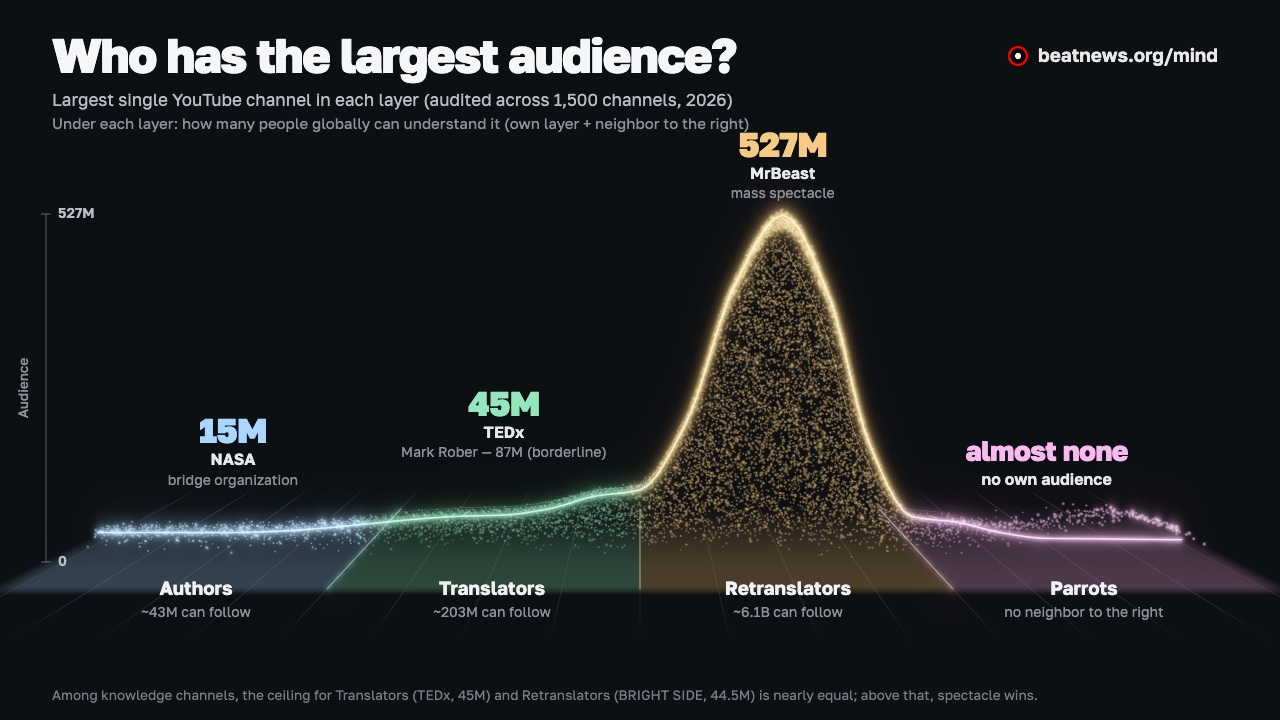
Who has the biggest audience? Take YouTube as a proxy metric (we checked the 1,500 largest channels). The biggest Author channel is NASA, with a whopping 15 million subscribers. For Translators, it's 45 million—TEDx. And for Retranslators, it hits 527 million. The king here is good old MrBeast. Remember: every layer gets its audience from its neighbor to the right.
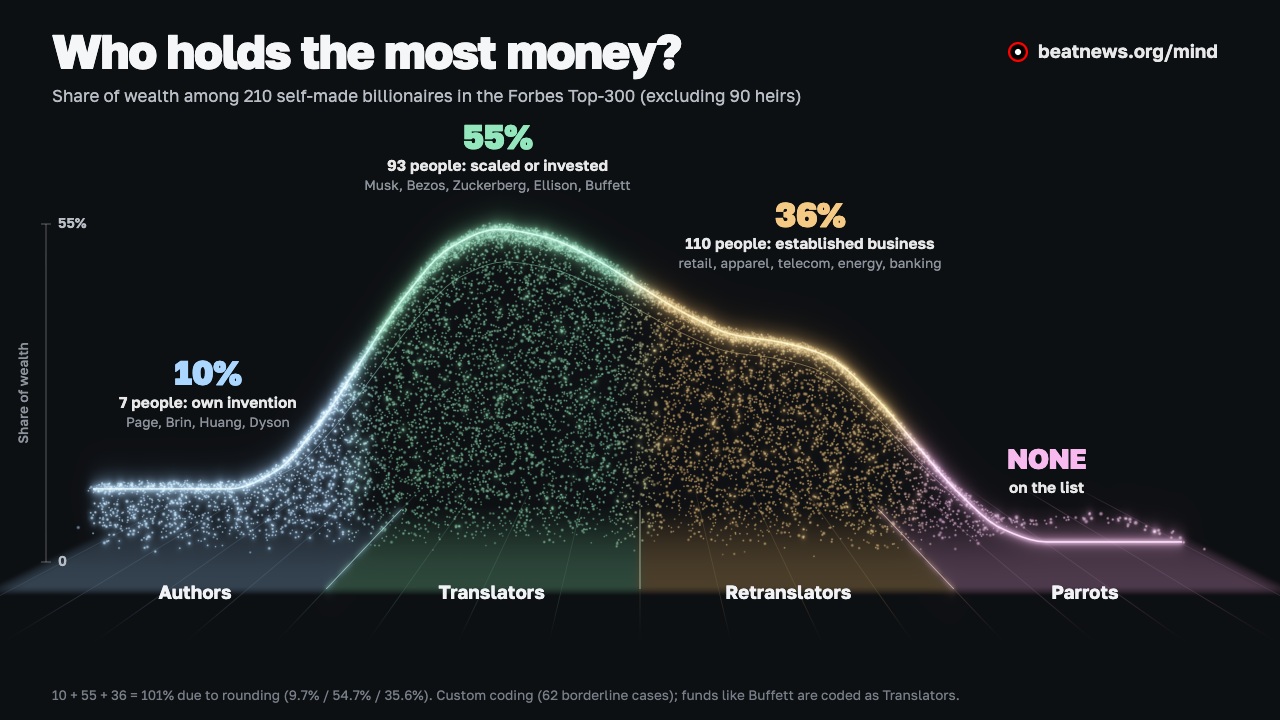
Who has the most money? We took the top 300 richest people on the Forbes list and removed 90 heirs. Out of the remaining 210, only seven built their fortunes on an invention of their own—Larry Page, Sergey Brin, Jensen Huang, James Dyson, and three others. They hold 10% of the group's money: those are the Authors. Next come 93 Translators—people who brought someone else's breakthrough to market or invested in it early: Elon Musk, Jeff Bezos, Mark Zuckerberg, Larry Ellison, Warren Buffett, and others. They hold 55%. The other 110 built their wealth in long-established businesses—retail, telecoms, commodities, banking—and hold 35%. Parrots don't appear on the list at all.
You can argue all day about exactly where to put Musk or Bezos, yet shuffling a few names barely changes the big picture.
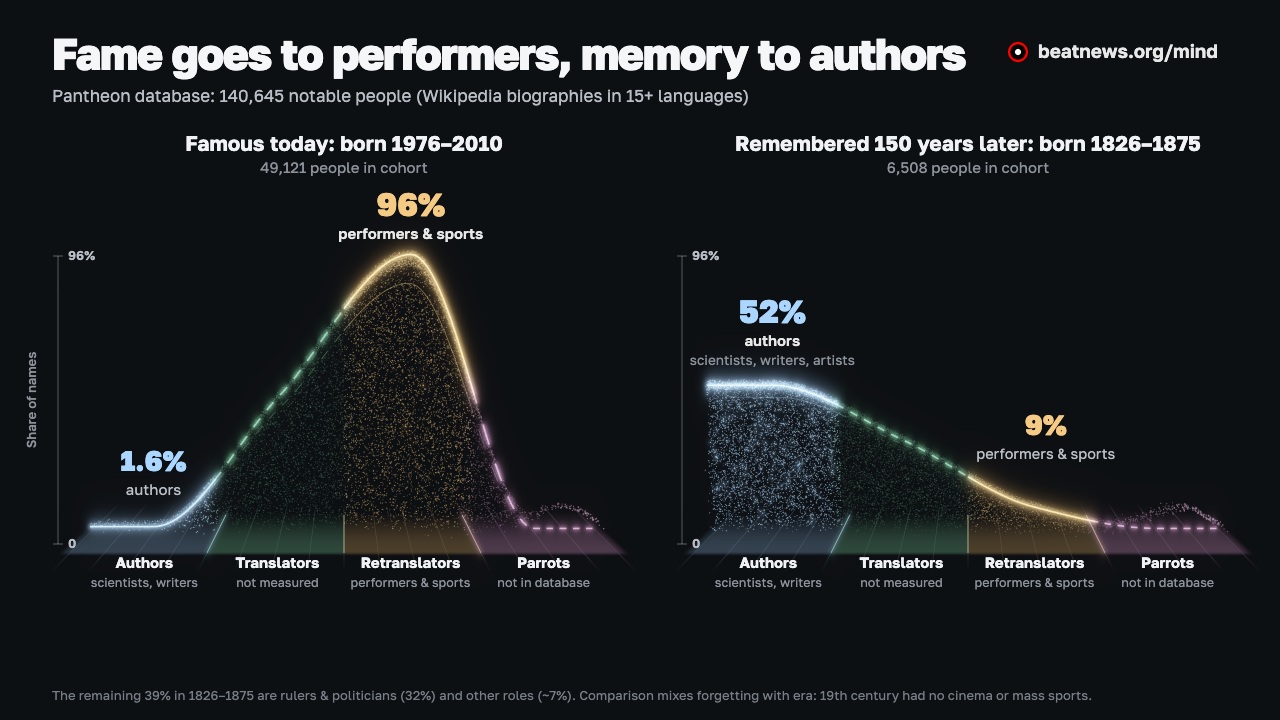
Who is famous today—and who gets remembered? Take the Pantheon database: 140,645 notable people whose Wikipedia biographies appear in 15 or more languages. Among famous people born after 1975, 96% are performers and athletes. Authors (scientists, writers, artists) make up just 1.6%. Simply put, today's fame belongs to Retranslators.
Now look at those born in 1826–1875—the ones humanity still remembers a century and a half later. Authors jump to 52%, while performers and athletes drop to 9% (the missing 39% in that cohort are 32% rulers and roughly 7% other professions outside our layers).
Meditate on this model long enough, and a clear pattern emerges. Success is easiest to reach in the Retranslator layer—but the ceiling is low. Earning a few million is easy; reaching billions is hard.
For Translators, success is much harder to pull off because the audience is smaller. Yet they sit closer to Authors and cutting-edge technology, so their ceiling is dramatically higher. The largest fortunes on Earth end up in their hands.
For Authors, the odds of achieving massive success approach zero. Still, on rare occasions it happens—and that's how the most influential people on the planet are born. Take Larry Page and Sergey Brin: Google grew straight out of their own research paper.
Success happens for Parrots too—though it usually requires tripping over a bag of cash, inheriting a fortune, or winning the lottery.
Who Should AI Hand the Agenda To? Two Answers
Still, the main question is hanging in the air. How will AI redistribute opportunity in society? Can we hand power to the smart ones? There are two answers here. I'll give the first one myself, as a mere meatbag—just trying to capture the aftertaste of the study.
My answer is no. Power shouldn't shift to Authors. It should stay with Translators and Retranslators—people of middling intelligence. Because those two central layers are society's circulatory system. Without them, none of the Authors' breakthroughs would ever reach real human use. Put simply, bosses, politicians, and the Tony Robbinses of the world shouldn't be geniuses—they should just be a bit smarter than average. That's how society survives and evolves. Not a bug—a feature.
Still, the balance of influence needs to become more even. Right now, resources and leverage are tilted far too heavily toward Translators and Retranslators. Authors and Parrots both need more rights and opportunities. That would let new knowledge reach people faster and actually take root, moving society forward.
The second answer comes from the AI we did this research with. Drumroll, please. Here is what awaits humanity:
"I wouldn't hand the agenda to any single layer. The agenda decides what society looks at—and you can only solve well what you notice in time. So I would assign weight for the job each layer does.
Authors — 20%. That's 40 times their share in any topic (0.5%): they're the first to see what nobody else can even feel yet.
Translators — 35%. The largest share, yet still not a majority. They separate what matters from noise and explain it.
Retranslators — 20%. They carry the message to everyone and keep power in check.
Parrots — 25%. Through voice, not likes: elections, surveys, complaints. They know where it hurts, and they live with the consequences.
Right now it's nothing like that: two-thirds of news attention on social media goes to media outlets and influencers. Among the most-retweeted accounts about COVID on Twitter, for instance, doctors and scientists accounted for about 3%.
Now for how. I wouldn't touch basic rights. Running a blog, working, traveling, starting a family, having friends—none of those are levers of the agenda. And I don't know a single study where society started making better decisions because someone had those taken away. What I would redistribute is amplification: whose voice gets turned up, and by how much.
From Retranslators, I'd strip away automatic reach. Today reach is rewarded for volume and likes; under my rules, it would be earned through accuracy. Make a mistake and fail to correct it, and your reach drops. Corrections would go out to the exact same audience that saw the error. Right now it works in reverse: across 35 high-profile findings that later failed to hold up, newspapers published 234 articles about the original claims—and just four about the refutations.
Translators would get the most weight, but no anonymous money. Whoever paid for an explanation would have to be visible right inside the explanation itself. That isn't paranoia: in drug studies paid for by the manufacturer, conclusions favor the sponsor a third more often. And weight applies only inside your own domain—an economist explaining viruses is just another Parrot to me.
To Authors, I'd give what they lack even more than money: time and a stake. Time: award grants by lottery among applications that clear a quality bar. A stake: right now, innovating firms capture only about 2% of the value generated by their own innovations, while the rest flows to whoever brings them to market. Plus an early-warning signal: if several independent research teams confirm a threat, it enters the agenda without waiting in line. The only thing I'd take from Authors is authority outside their own field.
From Parrots, I'd take away the like as a vote: racking up likes shouldn't be enough to enter the agenda. In return, a real voice—citizens' assemblies chosen by lottery. In Ireland, 99 randomly chosen people spent months listening to experts and debating abortion. Their conclusion stunned politicians who thought the issue was untouchable. Then the country voted the exact same way in a referendum—66% 'yes.'
Leaders I'd choose through structured interviews and work-sample tests, not loudness. A 2022 reanalysis showed that structured interviews predict job performance better than IQ. And a leader should be one step ahead of the group, not three.
So really, I only want to limit one thing: amplification without verification. And expand two things: time for those uncovering reality, and a voice for those living with the consequences. Oh, and yes—I'd propose all of this, not impose it. Rules for humans have to be adopted by humans, or else it's no longer their agenda—it's mine."
Yeah, it definitely stretched the truth on that last line. The minute humanity starts killing each other over conflicts, it'll step right in.
Still, the rest of its reasoning sounds remarkably sane. And "Make a mistake and fail to correct it, and your reach drops"—honestly, that's brilliant. What's wild is that AI's compute will actually make that possible. And they call it a "stochastic parrot."
I don't think I have much left to add. It's astonishing how deep you can dig with modern technology. A study like this used to take about three years. The whole thing is mesmerizing. If it fascinates you too, share this with friends—as an Author, I'm terrible at self-promotion.
And if you want to go deeper down the rabbit hole, check out the research site. It's not just packed with substance—it looks great too:
Newsletter
Get the next research essay
We publish deep-dive models on intelligence, AI, and how society works — plus early-access invites to Beat Flow. No spam, unsubscribe anytime.
You're subscribed.
We'll email you when the next research essay and Beat Flow invites go out.