How many smart people are in the world?
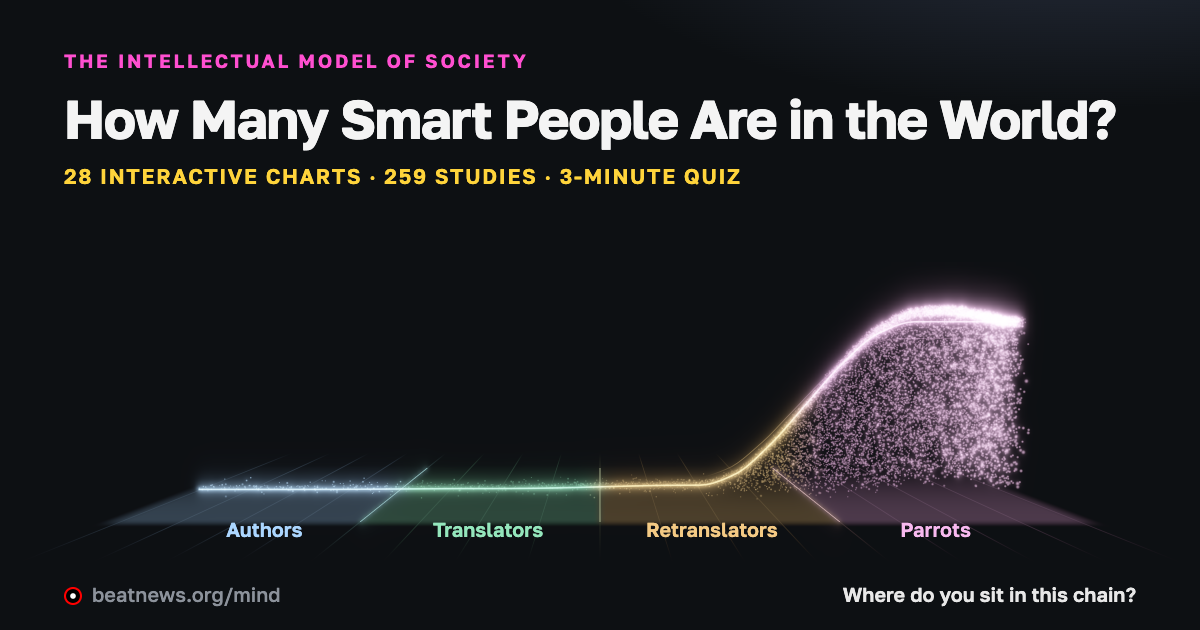
Every layer's audience is its neighbor to the right: roughly 43 million people can consume primary knowledge directly (Authors and Translators — seven in a thousand); everyone else hears it retold.
Top: global headcount by primary occupation (ages 15+). Below: share of roles within any single topic.
The 3D scene couldn't start on this device — showing a flat chart with the exact same data.
Create. Draw directly from the raw world and produce knowledge that didn't exist before. The scientist with a new finding, the engineer with a first working prototype, the writer with a new form. They are few, hard to hear, and paid less than you'd expect.
Translate. Take someone else's breakthrough and bring it to people: explain it, build it into a product, take it to market. R&D engineers, founders commercializing breakthroughs, directors and designers, rigorous science communicators. Understanding the genuinely new and making it useful is rare.
Simplify. Take what's already been explained and compress it into one quick takeaway. Short-form clips, "five rules of success," teaching straight from the textbook. They rarely reach the primary source — yet everyone hears them and pays them gladly.
Repeat. Take ready-made ideas and pass them along as-is: no verifying, no reframing in their own words. The largest layer — not an insult, just a role outside your specialty. You spend more time here than you'd like to admit.
Learn more about the model
Essay: "How Many Smart People Are in the World?"
Roughly a hundred Fable, Opus, Carbon, and Neon agents cross-checked data and audited each other to answer one simple question: "If smart people don't win power, wealth, or fame — how smart are they really?"
- How the four-layer model emerged
- How the split shapes money, reach & fame
- How AI will redraw society's agenda
Quiz · 3 minutes · no signup
Where do you sit in this chain?
{n} questions total: fifteen across five areas of life (health, money, work, news, hobbies) plus three quick attention checks at the end. A layer is a role inside a topic, not a lifelong label or an insult — the same person can be an Author at work and a Parrot about health. Answer how you actually act, not how you think you should. Your profile appears right here with a shareable link.
First, be honest: which layer would you put yourself in?
Question of
Key studies on intelligence and society
Evidence behind the curveEvidence on the claim "".
No study cards in this topic yet.
Newsletter
Get the next research essay
We publish deep-dive models on intelligence, AI, and how society works — plus early-access invites to Beat Flow. No spam, unsubscribe anytime.
You're subscribed.
We'll email you when the next research essay and Beat Flow invites go out.